what is the easiest paint to paint a car
Learning how to paint a auto in your garage and how to paint a wall in your house are far from the aforementioned thing. Ane chore requires a few paint rollers and a can of pigment, while the other involves a litany of products, clear coats, primers, and sprayers. That's why professional person machine pigment jobs can get so pricey.
The procedure is complex and there'south some skill involved, but that doesn't mean you tin can't learn how to paint a car and give your ride a new look. Here's how to paint a car on your ain.
How to Paint a Car Tip #1: Notice Some Time and Stock Upward on Supplies
Commencement: gear up aside time for this project. A paint job can take anywhere from several days to a couple of weekends, then finding a shed or garage—or something shielded from the elements—is of import. Once yous secured your painting location and set aside time to become the job done, you're ready to assemble your materials.
But you'll need more than than just paint. Essential tools include 1200- and 2000-grit wet-and-dry sandpaper, an electrical sander, masking tape, an air compressor or a spray gun, newspapers for masking off, face masks, rubber glasses, and paint thinners.
And if y'all can afford a grit extractor, get 1. It's not essential, but information technology will help keep the air gratis of debris.


For a pocket-sized- or medium-sized vehicle, you'll need approximately 1 gallon of base glaze or primer, 3 gallons of topcoat, and 2 to 3 gallons of clear glaze. Larger vehicles will crave near one and a half gallons of base coat, 4 gallons of topcoat, and three to four gallons of articulate-coat lacquer. These amounts are likely more than what yous'll demand—and professionals will employ less—but it's better to have as well much paint as opposed to too niggling.
If you want to friction match the original color of your car, find the color code located on your car's compliance plate. An auto paint shop will also be able to friction match information technology.
How to Pigment a Car Tip #2: Put in the Prep
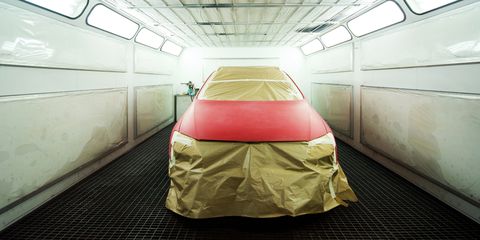
Once you have your supplies, y'all should move onto preparing your workstation. Start, clean your working area. If you're working inside a shed or garage, sweep the floors and make sure you have plenty of space to work. Obstacles in the way volition merely brand the job harder.
If you're working exterior, hose downwards the surface area with water to settle the dust, and don't pigment underneath a tree—or annihilation else, for that matter. Contaminants can drib onto the wet paint and ruin the finish. Then, launder the car to remove any surface contaminants such as dirt, grease, and road grime.
Before you lot start sanding and applying primer, determine what yous want to paint. Do you desire to paint the engine bay, trunk, or inner doorsills? Painting these tin add time and complication to the projection, especially if you're going to paint the engine bay, which could require some mechanical cognition to remove the engine and other accessories. If you lot're looking to ameliorate the exterior, mask off the areas you lot don't want to paint.
How to Paint a Car Tip #3: Strip It Downward

With your work area clean and a shelf full of painting products, you're at present ready to go to piece of work. You'll start by sanding in circular motions, removing the articulate coat, top glaze, and base glaze. This can be done with a sander, though y'all'll like have to sand the corners and crevices by hand.
To accomplish the best finish, sand the unabridged car back downwards to the bare metal, giving the new prime coat a perfectly smooth surface to adhere to. If you're operating under a time constraint, then sand the surface to as smooth and equally fifty-fifty as possible.
Once the car is stripped to your desired surface, wipe downwardly the exterior with a clean rag and paint thinners. This will help remove whatever dust, and so wait until any rest from the thinners evaporates earlier continuing.
How to Pigment a Car Tip #4: Get Ready for Prime number Time
Mask off the areas y'all don't want to paint and then mix the primer with the thinners. You'll need to read the instructions for the correct ratio.
Before you begin painting, it's all-time to do. The best way to practise is to become a cheap used car panel from a junkyard or a slice of steel if lugging a door home isn't your loving cup of tea. Concur the spare gun approximately six inches from the panel and spray in a side-to-side sweeping motility. You'll want only to apply the trigger when you're moving the spray gun. If you continuously hold the trigger down, you lot'll go a continuous spray of paint. This will lead to the paint being thicker in some spots, which could cause the paint to run.
With your painting technique mastered, you lot can beginning applying the primer to the auto. Yous'll want to work from the roof down, applying it in thin, even coats. It usually takes two or three coats to cover a surface. Each coat will take about 10 minutes to utilise per vehicle panel and another 20 minutes-to-an-hour for the primer to cure betwixt coats.
When you're finished, the primer volition have a powdery finish, which you lot'll need to smooth with 2000-grit wet-and-dry sandpaper. You'll also want to make clean the spray gun and and so wipe down the primed and cured surface with a rag slightly dampened with thinners. Using too much thinner could strip the primer, so exist conscientious.
How to Pigment a Car Tip #5: Paint Your Masterpiece

Now, y'all're ready to pigment. Mix the pigment with the thinners using the recommended ratios on the paint instructions. You'll employ the aforementioned spraying technique y'all used to apply the primer for the topcoat. But like the primer, information technology should accept you nearly 10 minutes per panel to apply the paint and another xx minutes to an hr for the paint to cure between paint applications.
Use 3 to 4 coats using the recommended drying time specified on the pigment can. Before you lot employ your last glaze of paint, remove any powdery residue with 2000-grit wet-and-dry out sandpaper and wipe down with a clean rag. Echo the previous two steps with the clear-coat lacquer.
Before the clear coat dries, remove the masking record used to mask off the areas where y'all didn't want paint applied, but be careful not to go any tape or paper stuck on the wet paint. Then, let the articulate glaze cure for the recommended fourth dimension. One time the articulate coat is cured, inspect the finished job for runs or other imperfections. If you find whatever, you tin sand dorsum the affected expanse with 2000-grit wet-and-dry out sandpaper and respray. Vitrify pigment in circular motions with a buffer. Exist conscientious not to fire the paint by holding the buffer in one spot too long.
With some practice and a methodical mindset, you lot tin learn how to paint a motorcar—and you'll have the satisfaction of doing it yourself while saving some money.
🎥 Now Picket This:
This content is created and maintained by a third political party, and imported onto this page to aid users provide their email addresses. You may be able to find more information about this and like content at pianoforte.io
Source: https://www.popularmechanics.com/cars/how-to/a3110/a-diy-guide-to-painting-your-car-15998013/
0 Response to "what is the easiest paint to paint a car"
Post a Comment